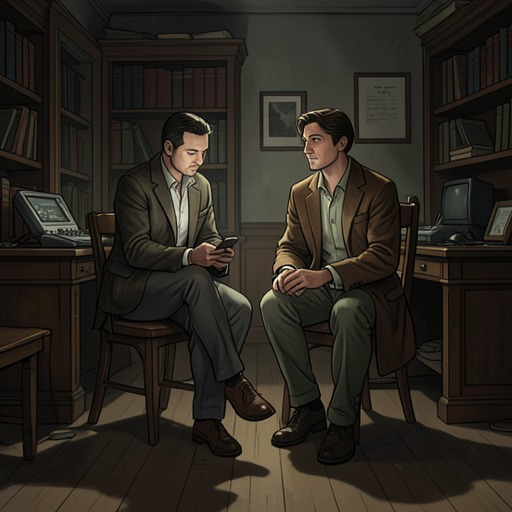
Último encuentro de Blanca y Santi en Cadaqués
También esto pasaráBlanca and Santi’s last meeting in Cadaqués is a quiet breakup scene in which physical intimacy fails to restore the relationship it once seemed to affirm. Alone in a hotel room, they confront the imbalance between what Santi offers and what Blanca still wants. By the time he leaves to answer his wife’s call, Blanca has said they should stop seeing each other and has recognized that she no longer loves him in the present tense.
Setting and Background
Blanca has never stayed in a hotel in Cadaqués. Although the view from its balcony is familiar, the hotel itself feels like foreign territory: a place where even company cannot dispel solitude, and where rest is brief, deep, and provisional. This setting gives their meeting an exposed, temporary quality. The room is not a home or a refuge; it is somewhere to wait, meet, and depart.
The encounter follows a different kind of romantic scene. Shortly beforehand, Blanca has been with Martí, who compares her to Cinderella finding a shoe that fits. She returns an alpargata, kisses him at the corner of his mouth, and hurries away, jokingly imagining that her princess’s dress will turn to rags. At the hotel, that light, fairy-tale image gives way to an affair shaped by haste, fatigue, and an existing marriage. The contrast sharpens the difference between the possibilities suggested by one encounter and the worn reality of the other.
Blanca arrives late, apologizing, and Santi tells her that he has almost no time. It is nearly midnight. He is not angry with her: she thinks he regards her outbursts and disregard as a price he must pay for the unequal nature of their relationship. She also understands the imbalance differently from him. In her view, what has never truly been given cannot truly be lost; if they separate, she will lose less.
Intimacy and Its Limits
Santi undresses Blanca methodically, with a slow, clumsy attentiveness. His eyes are red and his mouth tastes dry; Blanca suspects that he has smoked a joint while waiting. She lets him continue, alert to the possibility that her own desire might catch up with the encounter. Instead, he comes after a minute and a half, gently and without bringing her with him. He spends the next ten minutes apologizing, though the shortage of time makes those minutes especially conspicuous.
Blanca tells him not to worry, but the reassurance is false. Her body cools; her lips dry; her desire remains in the room without a clear object. The scene makes the gap between physical contact and mutual fulfillment concrete. Santi’s touch is present, but it does not produce the shared release Blanca had been waiting for. His apology cannot close that distance, and her lie merely keeps the encounter moving toward its end.
The hotel’s temporary solitude therefore does not make the affair intimate in any lasting sense. Blanca is attentive to her own body and to the moment that never arrives, while Santi’s exhaustion and lack of time delimit what he can give. Their physical closeness exposes, rather than repairs, the emotional inequality she has already sensed.
The Decision to End the Affair
As they speak, Santi smiles, and Blanca looks closely at him. The man she once loved had seemed to be a whole, partly through the protective inventions of her love. Now the image falls apart: his tanned skin, four-day beard, dry martinis, wolf-like hands, and old festival bracelet resolve into a collection of qualities and defects. She does not judge him ugly; she sees that he is no longer transformed by her love into the singular man she had believed him to be.
Their conversation turns toward his wife. Blanca imagines the woman in a turquoise-blue tunic whom she saw at the butcher’s, and reflects on how cruelly people can speak about those they love. She tells Santi that one day she will no longer love him. He appears more troubled by the possibility that his wife might find another man than by Blanca’s eventual indifference. His response suggests that he has treated what happened once as an isolated disaster, not as something that could happen again or alter the terms of his life.
Santi then says he has not had sex with his wife for a long time. Blanca finds the disclosure repugnant and tells him it is not her concern; until this meeting, he had never discussed the intimacy of his marriage with her. She follows that refusal with the clear decision that they should stop seeing each other. The disclosure does not draw them closer. It makes the boundaries of their arrangement harder to ignore: Santi’s marriage is not an abstract complication but a life that can enter the room, while Blanca refuses to take responsibility for its private terms.
Santi protests that what he gives her is very little, but that he cannot stop seeing her, and says he loves her very much. Blanca realizes that she has already begun to hear his love in the past tense: he loved her, rather than loves her. She does not say this aloud. The effort to measure their feelings would, she thinks, be a futile and humiliating conversation, especially now that the decisive change has already happened within her.
Departure and Significance
At that moment, Santi’s phone rings. His wife has returned from a concert in another town and is calling for him. He checks the expensive watch his father-in-law gave him, wearing it almost like an engagement ring, and says he must go. The watch makes his connection to his married life visible at the very moment that life summons him away. Blanca answers that she must leave too.
Santi asks whether they will meet soon, then presses his lips passionately and clumsily against hers. Blanca’s lips are inert. As he walks away, she notices that his legs are crooked. The detail is small and unceremonious, but it belongs to the same changed way of seeing him as the inventory of his face and clothes: love no longer smooths over the ordinary, imperfect person before her.
The meeting ends without a reconciliation or a grand gesture that could restore the affair. Its decisive movement is instead a shift in what Blanca can see and admit: the unsatisfying encounter, the exposure of Santi’s marriage, and his limited declaration of love all confirm a separation already under way. The farewell kiss preserves the old performance of passion for an instant, but her unresponsive body makes the change plain. What remains is not a renewed bond but Blanca’s recognition that the relationship has reached its end.